


Specific Vertical Injection Moulding Machine
Product Overview
The Vertical Injection Moulding Machine is designed for insert moulding and overmolding applications where vertical clamping provides convenient access to the mould and supports gravity-assisted insert placement. Metal terminals, pins, threaded components, and stamped parts can be positioned in the lower mould half before mould closure, depending on the insert geometry and mould design.
The vertical configuration is suitable for manual, semi-automated, and automated production processes. Machine configurations can include stationary platens, single or double sliding tables, and rotary index tables, allowing insert loading, moulding, inspection, and unloading processes to be arranged according to production requirements.
The machine series combines a rigid four-tie-bar clamping structure with hydraulic or servo-driven injection configurations, depending on the model. Automation interfaces can also be configured for applications using robots, vision inspection, automatic feeding, or other production-line equipment.


Product Categories
Latest Products


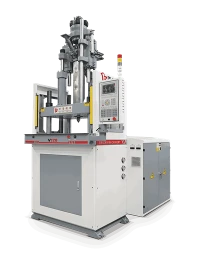
Machine Structure & Configuration
Uses a direct-acting hydraulic clamping structure. Machine platens and the frame are engineered for the required clamping force and mould dimensions. Guide systems support controlled platen movement during mould opening and closing.
Features a reciprocating screw configuration equipped with hydraulic or servo-driven injection systems depending on the machine model. Screw and barrel configurations can be selected according to the processed material and application requirements.
For engineering plastics and filled materials, wear-resistant screw and barrel configurations can be considered based on the material formulation, glass-fiber content, processing temperature, and production requirements.
Stationary Platen: Suitable for applications where inserts are loaded directly into the mould.
Single Sliding Table: Allows insert loading and part removal outside the main moulding position while the machine operates at the moulding station.
Double Sliding Table: Provides two lower mould positions for alternating loading and moulding operations.
Rotary Index Table: Available in multi-station configurations for processes requiring sequential insert loading, moulding, inspection, or unloading.
Configured according to the machine model and application requirements, featuring pressure and speed monitoring, machine safety circuits, and interfaces for external automation equipment (safety light curtains, safety relays, and mechanical safety devices).
Key Features
Vertical Moulding Configuration: Provides direct operator access to the lower mould area and supports gravity-assisted placement of many insert types.
Insert Moulding Capability: Suitable for metal terminals, pins, threaded inserts, and stamped components when matched with an appropriate mould and loading method.
Flexible Table Configurations: Stationary, sliding, and rotary table options allow the machine layout to be adapted to different insert-loading and production processes.
Injection System Options: Hydraulic or servo-driven injection configurations can be selected according to machine model, material, and process requirements.
Automation Integration: Machine interfaces can be configured for Cartesian robots, articulated robots, automatic feeders, vision inspection systems, and other auxiliary equipment.
Application-Specific Design: Screw and barrel materials or surface treatments can be selected for different thermoplastic materials and abrasive formulations.
Safety-Oriented Architecture: Safety devices and control functions are configured according to the machine model, production process, and applicable safety requirements.
Technical Specifications
|
Model Series |
Clamping Force (kN) |
Screw Diameter (mm) |
Injection Capacity (g / PS) |
Max. Injection Pressure |
Tie-bar Spacing (H x V, mm) |
Total Power (kW) |
|
VIM-35T |
350 |
22 / 25 / 28 |
32 / 41 / 52 |
To be confirmed |
360 x 280 |
11.5 |
|
VIM-55T |
550 |
25 / 28 / 32 |
52 / 65 / 85 |
To be confirmed |
420 x 320 |
15.0 |
|
VIM-85T |
850 |
32 / 35 / 40 |
85 / 102 / 133 |
To be confirmed |
480 x 360 |
22.0 |
|
VIM-120T |
1200 |
38 / 42 / 45 |
145 / 177 / 203 |
To be confirmed |
550 x 420 |
28.5 |
|
VIM-160T |
1600 |
42 / 45 / 50 |
203 / 233 / 287 |
To be confirmed |
620 x 480 |
35.0 |
Additional Selection Parameters
For precise machine selection, buyers should confirm the following parameters against their mould and production requirements:
Maximum mould dimensions & Platen dimensions
Minimum and maximum mould height & Maximum daylight
Ejector force and stroke & Sliding table dimensions and stroke
Rotary table diameter and number of stations
Machine dimensions, weight, and required automation equipment
Applications
Automotive Electronics: Sensor housings, relay components, busbar-related parts, terminals, and other metal-plastic components requiring controlled insert placement and overmolding.
Electrical and Connectors: Terminal blocks, pin headers, connectors, switches, and other electrical components where metal inserts need to be positioned in the mould before plastic injection.
Medical Components: Selected medical and laboratory components such as instrument handles, connector-related parts, and moulded components incorporating metal inserts (subject to required material, mould, production environment, and validation requirements).
Consumer and Industrial Hardware: Appliance components, power-tool parts, threaded inserts, switches, and decorative or functional metal-plastic components.
Manufacturing & Quality Control
Structural Manufacturing:
Machine frames and platens are manufactured according to mechanical and dimensional specifications. Stress-relief treatment is applied before precision machining to control dimensional stability during subsequent manufacturing operations.
Component Inspection:
Key mechanical, hydraulic, and electrical components undergo incoming quality control (IQC) procedures according to strict supplier standards.
Assembly & Testing:
Post-assembly functional testing covers clamping, injection, hydraulic operation, electrical control, and safety circuits.
Quality Documentation:
Inspection records, machine test results, electrical documentation, hydraulic diagrams, operating instructions, and spare-parts lists can be provided according to order requirements.

Tailored Engineering Options:
Customized single or double sliding tables & multi-station rotary tables
Application-specific screw and barrel configurations (PM steel / bimetallic)
Hydraulic core pull circuits & pneumatic/hydraulic valve-gate control interfaces
Robot, automatic feeding, and vision-based inspection interfaces
Customised platen dimensions, daylight requirements, and auxiliary equipment integration
Engineering Support: Buyers can provide mould drawings, part drawings, material specifications, insert details, target cycle time, production volume, and automation requirements for a comprehensive engineering evaluation.
FAQ
We are one of the most professional specific vertical injection moulding machine manufacturers and suppliers in China. We warmly welcome you to buy customized specific vertical injection moulding machine at competitive price from our factory. If you have any enquiry about pricelist and quotation, please feel free to email us.
BMC Vertical Injection Moulding Machine, Ceramic Injection Moulding Machine, Connector Insert Overmoulding Vertical Machine