


Servo Hybrid Vertical Injection Moulding Machine
Product Overview
The Servo Hybrid Vertical Injection Moulding Machine combines a servo-driven hydraulic system with a vertical clamping and injection configuration for insert moulding and overmoulding applications.
The vertical layout allows metal pins, terminals, lead frames, threaded inserts, and other components to be positioned in the lower mold half before mold closing. This configuration is particularly suited to applications where insert positioning and operator access to the mold are important parts of the production process.
The hydraulic drive system combines a permanent magnet synchronous servo motor with an internal gear pump. Servo output is adjusted according to hydraulic demand, while the closed-loop control system monitors key molding parameters during the injection cycle.
The machine can be configured for engineering thermoplastics and other molding materials according to the screw, barrel, injection unit, mold, and processing requirements.


Product Categories
Latest Products


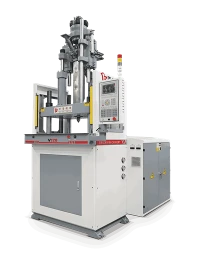
Machine Structure & Configuration
Clamping Unit
The machine uses a vertical clamping configuration with hydraulic actuation and position feedback. The clamping system can be configured according to the required mold size, clamping force, stroke, and insert-moulding process.
Injection Unit
A balanced injection-cylinder arrangement supports controlled screw movement during injection and plasticizing. Screw diameter, injection capacity, and injection pressure can be selected according to the material and part requirements.
Servo-Hydraulic Drive System
The hydraulic power unit combines a permanent magnet synchronous servo motor with an internal gear pump. Servo output is adjusted according to hydraulic demand rather than operating continuously at a fixed output.
Control System
An industrial touchscreen and PLC-based control architecture provide control of molding parameters and machine functions. Closed-loop feedback can be used for injection velocity, pressure, and screw-position control.
Slide and Rotary Configurations
Depending on the production process, the machine can be configured with:
Single-slide table
Dual-slide table
180-degree two-station rotary table
120-degree three-station rotary table
Other customized insert-loading configurations
These configurations can be selected according to mold design, insert-loading method, operator access, and automation requirements.
Plasticizing Assembly
Screw and barrel assemblies can be configured with wear-resistant materials and surface treatments for different resin requirements. Options include ion-nitrided alloy steel and bimetallic screw and barrel configurations for applications involving abrasive, corrosive, or engineering materials.
Machine Base and Platens
The machine frame, base, and platens are designed for the clamping loads associated with the selected machine tonnage. Structural analysis and machining processes can be applied during machine engineering and manufacturing to control dimensional accuracy and structural alignment.

Key Features
Servo-Hydraulic Operation
The servo-hydraulic system adjusts motor output according to the machine's hydraulic demand. During periods with limited hydraulic demand, such as parts of the cooling or dwell cycle, servo motor speed can be reduced accordingly.
Actual energy consumption depends on machine configuration, molding material, cycle time, mold design, and production conditions.
Closed-Loop Process Control
Feedback from injection velocity, pressure, and screw position can be used by the control system to monitor and adjust the molding process.
This provides process information that can be used when setting and repeating molding cycles.
Insert Moulding Configuration
The vertical mold arrangement provides direct access to the lower mold area for positioning metal inserts and other components before mold closing.
Depending on the machine configuration, slide tables or rotary tables can be integrated to separate insert loading from the molding cycle.
Operator Safety
Safety configurations can include:
Dual-hand cycle-start controls
Mechanical safety locks
Safety interlocks
Optical light curtains
Low-profile operator work area
The final safety configuration can be adapted to the machine design and applicable destination-market requirements.
Automation Integration
The machine can be configured for integration with Cartesian robots, insert-feeding systems, part-removal equipment, and other peripheral automation.
Industrial communication interfaces can be selected according to the automation system and control requirements.
Technical Specifications
The following specifications represent standard configurations. Final specifications may vary according to machine configuration, mold requirements, injection unit selection, and customization.
|
Technical Parameter |
Unit |
Model VHS-35 |
Model VHS-85 |
Model VHS-150 |
|
Clamping Force |
kN (Tons) |
350 (35) |
850 (85) |
1500 (150) |
|
Screw Diameter |
mm |
22 |
32 |
45 |
|
Theoretical Shot Volume |
cm3 |
38 |
115 |
318 |
|
Injection Pressure |
MPa |
220 |
210 |
205 |
|
Max. Injection Speed |
mm/s |
180 |
200 |
220 |
|
Distance Between Tie-Bars |
mm |
360 x 310 |
460 x 420 |
580 x 520 |
|
Min./Max. Mold Height |
mm |
150 - 320 |
200 - 420 |
250 - 520 |
|
Platen Stroke |
mm |
250 |
350 |
450 |
|
Servo Motor Power |
kW |
7.5 |
15.0 |
25.0 |
|
Machine Weight |
Approx. t |
1.8 |
3.2 |
5.5 |
Model Selection Considerations
Selecting a vertical injection moulding machine involves more than comparing clamping force.
The following information should be considered when selecting a model:
Required clamping force depends on mold size, projected part area, material, cavity configuration, and molding conditions.
Screw diameter and theoretical shot volume should be considered together with the required part weight, runner system, number of cavities, and molding material.
Tie-bar spacing, mold height, platen stroke, and available mold space should be checked against the customer's mold drawings.
The size, shape, quantity, and loading method of the inserts can affect the choice between a fixed table, slide table, or rotary configuration.
Customers planning automated insert loading or part removal should define the required robot interface, cycle sequence, peripheral equipment, and communication requirements.
For quotation and model confirmation, customers should provide the mold dimensions, part drawings or samples, material, part weight, insert information, cavity number, and expected production cycle where available.
Automotive Components
Suitable for insert moulding and overmoulding of components such as metal terminals, sensor-related components, connector housings, and other plastic-metal assemblies, subject to part and material requirements.
Electrical and Electronic Components
The vertical configuration can be used for molding around terminals, lead frames, threaded inserts, contacts, and other components that require controlled insert positioning.
Medical Components
The machine can be configured for precision insert moulding applications involving plastic housings and small components where controlled insert placement is required. Specific medical applications should be evaluated according to material, mold design, cleanliness requirements, and production conditions.
Industrial Hardware
Suitable for overmoulding or insert moulding of grips, fastening components, tool-related parts, and other plastic-metal assemblies.
Elastomer and Engineering Material Applications
With an appropriately configured screw, barrel, injection unit, and mold, the machine can be used with selected engineering thermoplastics and elastomeric materials according to processing requirements.
Manufacturing & Quality Control
CNC Machining
Machine bases, platens, clamp components, and other structural parts can be machined using CNC boring and milling equipment. Machining processes are selected according to the dimensional and alignment requirements of each component.
Hydraulic System Cleaning
Hydraulic manifolds and related hydraulic components can undergo cleaning and flushing procedures before assembly to help control contamination within the hydraulic circuit.
Assembly and Process Inspection
Machine assembly includes inspection of major mechanical, hydraulic, electrical, and control-system components according to the machine's production and inspection procedures.
Factory Testing
Before shipment, the machine can undergo factory testing to verify machine operation, control functions, hydraulic operation, molding-cycle functions, and other specified requirements.
For projects requiring customer-specific acceptance testing, FAT procedures can be defined according to the agreed machine configuration and acceptance criteria.
OEM & Customization
The machine can be configured according to mold design, material requirements, insert-loading method, automation level, and destination-market requirements.
Additional hydraulic core-pull circuits can be integrated where the mold requires hydraulic slide or core mechanisms.
Screw and barrel materials and surface treatments can be selected according to the processing characteristics of the customer's material. Wear-resistant or bimetallic configurations are available for suitable abrasive, corrosive, or engineering materials.
For materials such as PEEK and other demanding engineering compounds, the screw, barrel, temperature-control system, and injection configuration should be evaluated according to the specific processing conditions.
Electrical components, control cabinet configuration, voltage, frequency, and safety functions can be adapted according to the destination market and project requirements.
The machine can be integrated with:
Cartesian robots
Insert-feeding systems
Part-removal systems
Conveyor systems
Rotary or slide-table automation
Production monitoring systems
Where required, communication interfaces and production-data functions can be configured for machine status monitoring, cycle-time recording, alarm history, and production-data integration.
FAQ
We are one of the most professional servo hydraulic vertical injection moulding machine manufacturers and suppliers in China. We warmly welcome you to buy customized servo hydraulic vertical injection moulding machine at competitive price from our factory. If you have any enquiry about pricelist and quotation, please feel free to email us.
Hybrid Vertical Injection Moulding Machine With Rotary Table, Hybrid Vertical Injection Moulding Machine, servo hydraulic vertical injection moulding machine