


Product Overview
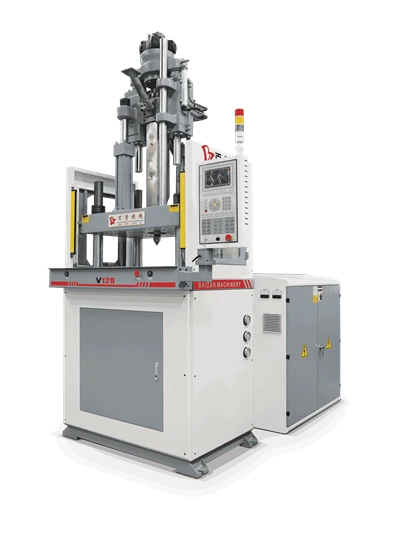
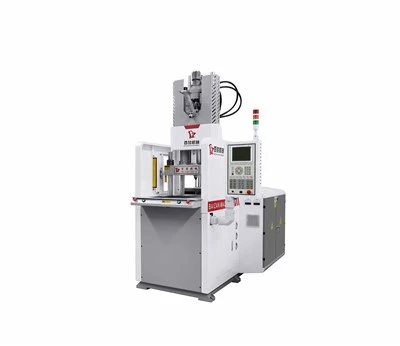
The Vertical Injection Molding Machine is engineered for insert molding, overmolding, and complex manufacturing applications where metal, ceramic, or pre-formed components must be positioned in the mold prior to polymer injection.
Featuring a vertical clamping and vertical injection layout, the design utilizes gravity to naturally seat inserts into the lower mold cavity, preventing alignment drift and simplifying both manual and automated production workflows.
Available in single-station, shuttle-table, and rotary-table configurations, the machine can be tailored to match specific mold sizes, clamping tonnages, shot volumes, and factory automation requirements. Typical applications include automotive electronics, wiring assemblies, industrial hardware, medical devices, and precision consumer components.






Product Categories
Latest Products


Machine Structure and Configuration
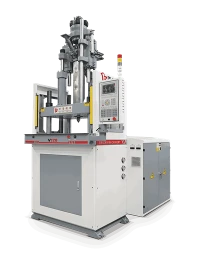
The vertical clamping structure provides unobstructed top-down access to the mold, allowing operators or robotic systems to place inserts directly into the lower cavity. Hydraulic clamping mechanisms deliver uniform pressure distribution across the parting line to prevent flashing on delicate insert edges.
The injection assembly is configured based on required shot volume, screw diameter, injection pressure, and processing resin. Standard configurations utilize nitride-hardened components, with bi-metallic and powder metallurgy upgrades available for abrasive engineering plastics containing glass or carbon fibers.
Equipped with variable displacement pumps and proportional pressure/flow control valves, the hydraulic architecture ensures smooth, repeatable movements while reducing idle-state energy consumption.
An advanced microprocessor-based industrial controller manages all machine functions, including injection parameters, clamping force, mold protection, temperature regulation, and auxiliary peripheral synchronization.
Single-Station: Ideal for standard, low-to-medium volume insert molding.
Shuttle-Table (Single/Double Slider): Features sliding lower platens to separate loading and molding zones, minimizing operator idle time.
Rotary-Table: Multi-station indexing tables (2 or more stations) that allow simultaneous insert loading, molding, and part extraction for continuous high-efficiency output.
Automated Cells: Designed for seamless physical and electrical integration with robots, bowl feeders, and automated inspection stations.
High-Resolution Process Control:
Digital linear transducers and closed-loop feedback monitor screw position, injection velocity, and V/P (velocity-to-pressure) transfer points to ensure consistent part density.
Automation-Ready Architecture:
Standard industrial communication interfaces and dedicated auxiliary I/O ports enable reliable handshaking with pick-and-place robots, automated feeders, and safety enclosures.
Gravity-Assisted Insert Retention:
Vertical mold movement allows inserts to rest stably in the lower mold half under natural gravity, reducing positioning errors and preventing mold damage.
Flexible Workcell Integration:
Modular layout supports manual, semi-automatic, and fully automated configurations tailored to specific part geometries and cycle time targets.
Programmable Mold Protection:
Sensitive low-pressure mold-closing monitoring halts and reverses platen movement instantly upon detecting any foreign obstruction or misaligned insert.
Technical Specifications
|
Model Parameter |
Unit |
VIM-35T |
VIM-75T |
VIM-150T |
VIM-250T |
|
Clamping Force |
metric ton |
35 |
75 |
150 |
250 |
|
Screw Diameter |
mm |
22 |
32 |
45 |
55 |
|
Theoretical Shot Volume |
cm3 |
38 |
115 |
320 |
580 |
|
Max. Injection Pressure |
MPa |
225 |
215 |
205 |
190 |
|
Tie-Bar Spacing (W x H) |
mm |
360 x 310 |
460 x 410 |
580 x 530 |
710 x 650 |
|
Mold Daylight Opening |
mm |
320 - 450 |
350 - 550 |
400 - 650 |
450 - 750 |
|
Ejector Stroke |
mm |
60 |
80 |
120 |
150 |
|
Total Motor Power |
kW |
7.5 |
15 |
22 |
37 |
How to Select a Vertical Injection Molding Machine
Selecting an appropriate vertical machine requires careful alignment between equipment parameters and operational constraints:
Clamping Force: Calculated based on projected part area, cavity pressure, and material characteristics.
Shot Volume: Determined by total shot weight (including runners), number of cavities, and polymer density.
Mold Dimensions: Must match or exceed available tie-bar clearance, platen dimensions, and daylight limits.
Insert Loading Method: Choose between manual, shuttle table, or multi-station rotary table layouts depending on cycle time and safety requirements.
Material and Wear Resistance: Select specialized screw/barrel metallurgy if processing filled, reinforced, or highly corrosive resins.
Automation Level: Factor in whether downstream part removal or automated feeding systems will be integrated.
Applications
The company conducted a competitive advantage analysis to identify its strengths and weaknesses compared to its rivals.
Automotive Components:
Overmolded electrical terminals, sensor housings, ignition pins, and vibration-resistant structural connectors.
01
Electrical and Electronics:
Miniature switches, plug connectors, relay parts, and lead-frame encapsulation.
02
Industrial Hardware:
Metal-to-plastic integrated hand tools, insulated grips, and threaded fastening inserts.
03
Medical Components:
Specialized labware, catheter connectors, and surgical instrument parts produced under controlled processing conditions.
04
Consumer Products:
Consumer appliance parts requiring multi-material construction or secure insert integration.
05

Manufacturing and Quality Control
Pre-sales consultation
Precision Machining: Platens, toggle linkages, and main structural weldments are machined on high-precision CNC boring centers to guarantee tight parallelism and alignment tolerances.
Cost saving
Component Verification: Hydraulic valves, electronic controllers, and pumps undergo strict incoming quality control inspections.
Stable delivery
Functional Dry-Cycling: Assembled machines undergo extended continuous dry-run testing to verify hydraulic responsiveness, pressure holding, and mechanical smoothness.
Authoritative inspection
Factory Run-Off and Documentation: Completed units undergo final operational testing, and ship with comprehensive data packages including operation manuals, electrical/hydraulic schematics, inspection records, and compliance documentation.
OEM and Customization
Hydraulic Core-Pull Integration:
Custom hydraulic circuits and sequence logic built directly into the control system for complex molds requiring core slides or unscrewing devices.
Wear-Resistant Plasticizing Sets:
Custom compression ratios and bimetallic alloys tailored to specific resin characteristics.
Regional Electrical Standards:
Control cabinets configured to match local industrial voltage and frequency requirements.
Turnkey Automation Integration:
Complete cell engineering including safety guarding, parts conveyors, optical vision inspection, and extraction robotics.
To receive an accurate engineering recommendation and commercial proposal, buyers can prepare the following details:
Product 2D drawing or 3D CAD model
Finished part weight and resin type
Insert material, dimensions, and loading orientation
Number of cavities and mold external dimensions
Target production volume and desired cycle time
Required automation level (manual, shuttle, rotary, or robotic)
Local factory power supply specifications

FAQ
We are one of the most professional vertical injection molding machine manufacturers and suppliers in China. We warmly welcome you to buy customized vertical injection molding machine at competitive price from our factory. If you have any enquiry about pricelist and quotation, please feel free to email us.
overmoulding machine