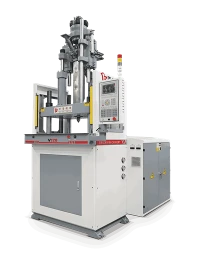
The global medical device industry continues to expand, driven by an aging population, increasing healthcare investment, and growing demand for disposable medical products. As medical manufacturers pursue higher product quality, tighter tolerances, and more efficient production processes, precision vertical injection molding has become an increasingly important manufacturing solution.
Medical components such as IV connectors, syringe parts, catheter hubs, luer locks, sensor housings, surgical instrument handles, and diagnostic device components all require exceptional dimensional accuracy and consistent quality. Many of these products also involve metal inserts or overmolding processes, making vertical injection molding machines an ideal choice for medical manufacturing.
Compared with conventional horizontal injection molding machines, vertical injection molding machines offer significant advantages for insert molding applications. Their vertical clamping structure allows inserts to be positioned more securely, reducing the risk of displacement during injection. This results in higher production accuracy, improved product consistency, and lower defect rates-critical factors for medical products that must meet strict quality standards.
In addition, modern precision vertical injection molding machines are equipped with advanced servo hydraulic systems, high-precision injection control, and stable temperature management. These features help manufacturers maintain repeatable production while minimizing material waste and energy consumption. As regulatory requirements for medical devices become more stringent, manufacturers are increasingly investing in equipment that delivers stable performance and reliable process control.
Automation is another key trend shaping the medical injection molding industry. Many production lines now integrate rotary tables, robotic handling systems, automatic insert loading, and vision inspection technologies. These intelligent manufacturing solutions improve production efficiency, reduce labor costs, and help maintain clean manufacturing environments required for medical applications.
The demand for minimally invasive medical devices, wearable healthcare products, and disposable diagnostic consumables is expected to continue growing in the coming years. As a result, the need for precision molding equipment capable of producing small, complex, and high-value plastic components will remain strong.
For manufacturers looking to enhance production quality and efficiency, precision vertical injection molding technology offers a reliable solution that meets the evolving requirements of the global medical device industry. With continuous innovation in machine design, automation, and process control, vertical injection molding is expected to play an even greater role in supporting the future of medical manufacturing.