The rapid development of new energy vehicles (NEVs) is creating new opportunities across the automotive components industry. As electric vehicles become more advanced, the number of electrical and electronic components inside each vehicle continues to increase, driving growing demand for high-quality connectors, wiring harnesses, terminals, and other precision components.
Connectors and wiring harnesses play a critical role in electric vehicles. They are widely used in battery systems, charging systems, motors, inverters, sensors, control units, and high-voltage electrical systems. Compared with traditional vehicles, NEVs require more complex electrical connections and higher requirements for insulation, durability, dimensional accuracy, and safety.
This trend is also increasing demand for precision injection molding technologies. Many automotive connectors and terminals require insert molding or overmolding, in which metal terminals, wires, or other components are placed into a mold and then encapsulated with engineering plastics. The process provides reliable insulation and mechanical protection while improving the overall strength and durability of the finished component.
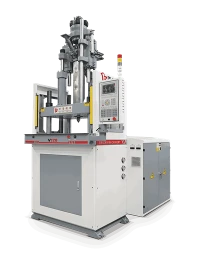
Vertical injection molding machines are particularly suitable for these applications. Their vertical clamping structure makes it easier to position metal inserts, terminals, and wiring harnesses before injection. Operators or automated systems can load inserts directly into the mold, while the machine provides stable clamping and injection during the molding process.
For insert molding and overmolding applications, vertical machines can also help manufacturers reduce insert displacement and improve production consistency. Rotary-table and sliding-table configurations can further improve productivity by allowing loading and molding operations to be performed efficiently within the production cycle.
As automotive manufacturers continue to pursue lightweight designs, higher electrical performance, and improved production efficiency, the requirements for precision and repeatability are becoming increasingly strict. Advanced vertical injection molding machines equipped with servo systems, precise injection control, automated insert loading, and robotic handling can help manufacturers meet these requirements while reducing production costs and material waste.
The continued expansion of the NEV industry is therefore expected to create further opportunities for manufacturers of connectors, wiring harnesses, terminals, and other precision automotive components. At the same time, demand for flexible and efficient injection molding solutions will continue to grow.
For manufacturers producing automotive connectors and wiring harness components, vertical injection molding provides an efficient solution for insert molding and overmolding applications. With the development of electric mobility, this technology is expected to play an increasingly important role in the next generation of automotive component manufacturing.